Hey everyone, Marcus Reyes here from Toledo, Ohio. You finally find what looks like a solid used family car. The price seems reasonable, the test drive feels good, and you’re already imagining weekend Costco runs with the kids. Then reality shows up six months later in the form of a $1,200 tire bill, a surprise insurance hike, and brakes that need replacing.
I’ve been there. Emily and I learned these lessons the hard way with our first couple of family vehicles. Noah and Sophie don’t care about the sticker price — they just need safe, reliable transportation that doesn’t turn every maintenance visit into a budget crisis. Today we’re talking about the three big costs that catch most buyers off guard: insurance, tires, and brakes.
Why These Costs Sneak Up on You
When you’re shopping, it’s easy to obsess over the purchase price and maybe fuel economy. But these three items often add up to more money over five years than you expect. They’re not glamorous, but they’re unavoidable if you actually drive the car like a normal family does.
Let’s break them down with real numbers so you can go into your next purchase with eyes wide open.
Insurance: The Monthly Bill You Can’t Ignore
Insurance is usually the second-biggest ongoing cost after fuel. A “cheap” car can become expensive fast if insurers see it as high-risk.
What affects your rate:
The make and model (family-friendly Hondas and Toyotas often insure cheaper)
Safety ratings and theft rates
Your driving record and location (hello, Toledo winters)
Deductible amount and coverage levels
Real example: A 2018 Honda CR-V might cost our family around $1,350–$1,600 per year. Switch to a sportier or less safe model and that same coverage can jump to $2,000+ easily.
Pro tip: Get insurance quotes before you buy. Call your agent with the exact year, make, model, and mileage. One phone call can save you hundreds a year. Also consider raising your deductible to $1,000 if you have a solid emergency fund — it can drop your premium noticeably.
Tires: The Silent Budget Killer
Tires are one of those things you don’t think about until you need them. For a family hauler in Ohio, expect to replace them every 40,000–60,000 miles depending on driving style and road conditions.
Current rough costs (2026):
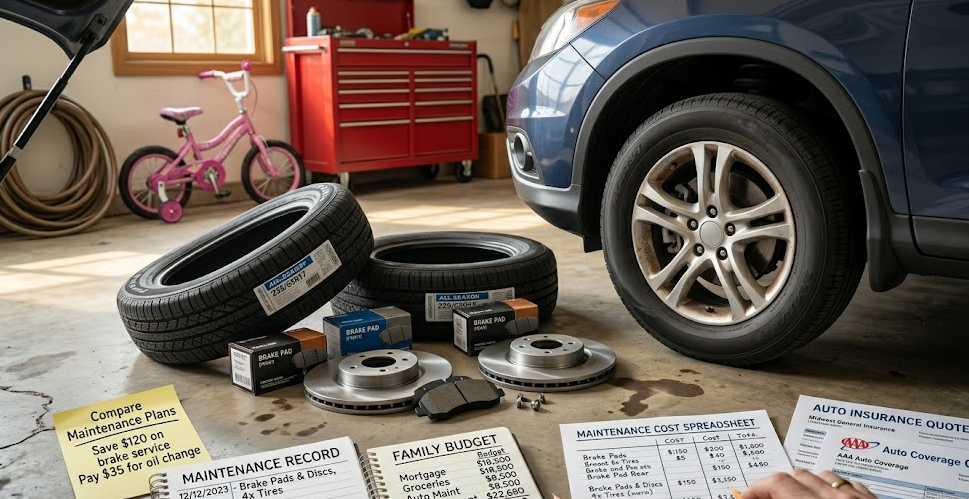
Good all-season tires for a midsize SUV or minivan: $650–$950 for a full set
Installation, balancing, and alignment: $100–$200 extra
Winter tires if you want max safety in snow: another $700–$1,000 set
Over five years of normal family driving (14,000 miles/year), most people will buy at least one full set. That’s $800–$1,200 you should budget annually when spread out.
I always check tire tread depth during inspections. If the tires are halfway gone on a car with 80k miles, factor in a new set immediately. It’s basically like adding $800 to the purchase price.
Brakes: Safety You Pay For Regularly
Brakes get used hard in family life — stop-and-go school runs, heavy loads from Costco, and kids who can’t sit still.
Typical lifespan in real life:
Brake pads: 30,000–50,000 miles
Rotors: 50,000–70,000 miles
Cost range:
Pads + labor (all four wheels): $400–$800
Pads + rotors + labor: $800–$1,400
These numbers add up fast. A neglected car might need brakes within the first year, while a well-maintained one can go longer.
The Real 5-Year Math for a Typical Family Car

Let’s use a realistic 2017–2019 Honda CR-V or similar as an example:
Insurance: $7,200 (5 years)
Tires (1.5 sets): $1,500
Brakes (1–2 jobs): $1,800
Total for these three: ≈ $10,500
That’s on top of purchase price, fuel, and regular maintenance. Suddenly that “great deal” doesn’t look quite so cheap.
How to Budget Like a Smart Toledo Parent
Build these into your decision — Run full ownership numbers before you fall in love with any car.
Choose cars known for lower costs — Reliable Japanese models usually win here.
Maintain proactively — Good driving habits, regular rotations, and addressing small issues early extend the life of tires and brakes.
Shop smart for parts — Quality tires and pads last longer and perform better. Cheap ones can end up costing more.
Consider your actual driving — If you do mostly highway miles, tires may last longer. City driving with kids wears brakes faster.
My Family’s System That Actually Works
Emily and I now keep a separate “car maintenance fund.” We put aside $150–$200 per month for all vehicle expenses. When tires or brakes come due, the money is already there. No more surprise panic.
We also inspect these items carefully during every test drive:
Measure tread depth
Look at brake pad thickness through the wheels
Ask for recent service records on brake and tire work
The Bigger Picture for Families
These forgotten costs are exactly why some “cheap” cars become expensive headaches. A $2,000 lower purchase price can disappear fast when you need new rubber and stoppers within a year.
Your family deserves peace of mind. A reliable car with predictable costs lets you focus on what matters — Friday night barbecues, Saturday soccer games, and spontaneous ice cream runs — instead of worrying about the next big bill.
Action Checklist Before Your Next Purchase
Get insurance quotes for the specific vehicles you’re considering
Inspect tire tread and brake condition thoroughly
Ask about recent maintenance on these items
Add realistic estimates for these costs into your 5-year budget
Build or maintain a dedicated car fund
Buy the car, not the story — and definitely budget for what it takes to keep that car safe and running smoothly.
Have you ever been surprised by a big tire or brake bill after buying a used car? Or found a model that’s surprisingly cheap to maintain? Share your experiences in the comments. I read every single one and it helps other families make better choices.
Drive safe and budget wisely,
Marcus Reyes
Toledo, Ohio